
4 min readBy Artcolor
What is an LED driver? Constant voltage vs constant current
An LED driver turns mains power into the steady low-voltage DC that LEDs need. How constant-voltage and constant-current drivers differ, and how to choose one for an LED strip.
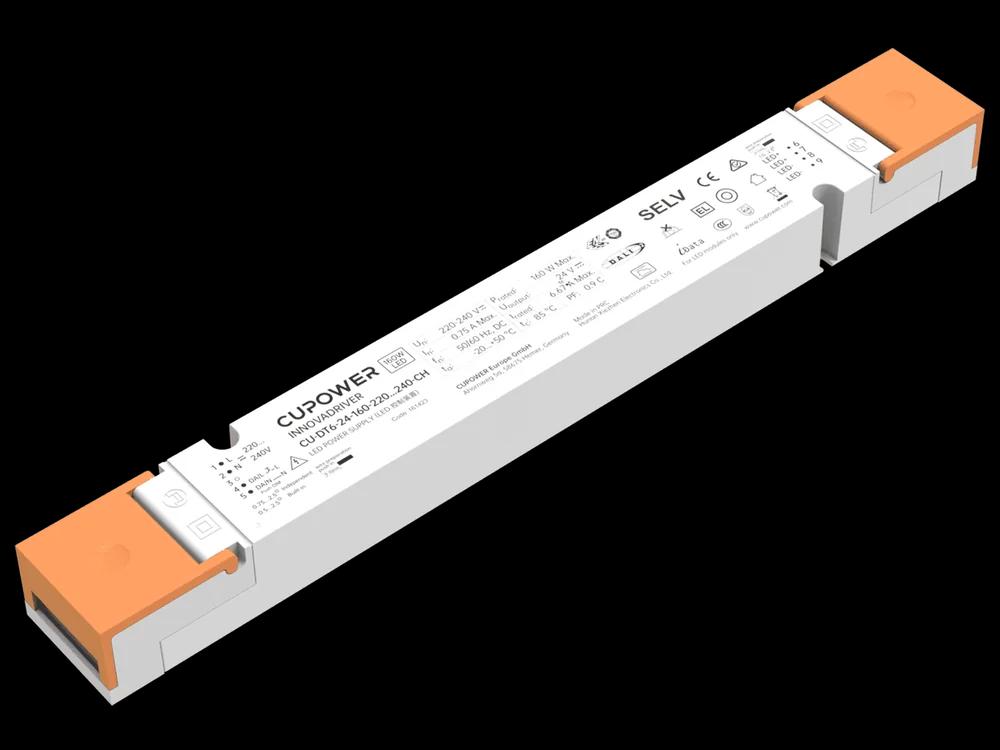
An LED driver is the power supply of an LED light. It takes mains AC power and turns it into the low-voltage DC that LEDs run on, and it holds that output steady while the load and the mains change. Many drivers also dim the light, from a wall dimmer, a control signal or a lighting-control network.
Constant voltage or constant current
There are two kinds of LED driver, and an LED light is made for one of them.
| Constant-voltage driver | Constant-current driver | |
|---|---|---|
| What it holds steady | The output voltage, such as 12, 24 or 48 V DC | The output current, such as 350 or 700 mA |
| Made for | LED strips, LED neon flex, flexible LED sheets and other loads with their own current control on board | LED modules and luminaires designed for a set current, such as many downlights |
| How loads connect | In parallel, up to the driver's rated power | As one load, or in series, within the driver's voltage range |
An LED strip needs a constant-voltage driver whose output matches the strip's rated voltage. A constant-current driver should only be used with an LED module or fixture made for it. Some drivers, such as MEAN WELL's ELG, HLG and XLG series, are listed as constant voltage + constant current; their datasheets say how to run them with a strip.
What Artcolor supplies
Artcolor supplies constant-voltage LED drivers for 12, 24, 36 and 48 V LED strips:
- CUPOWER: 24 V drivers with DALI-2 DT6 dimming or DT8 tunable white (40 to 240 W), a 24 V driver with Casambi wireless control and five PWM channels, and 48 V on/off drivers (96 to 160 W). All are IP20, for indoor or enclosed mounting.
- MEAN WELL: 168 models in eight series from 20 to 600 W. LRS enclosed supplies for indoor use; LPV, ELG, HLG and XLG waterproof drivers rated IP67; and PWM drivers that dim a strip from a 0–10 V, 10 V PWM or resistance signal, over DALI-2 or over KNX.
Choosing a driver for an LED strip
- Match the voltage. A 24 V strip needs a 24 V output. The wrong voltage leaves the strip dim, or damages it.
- Size it by the load. Multiply the strip's watts per metre by the length on that output: a 14.4 W/m strip, 5 m long, is a 72 W load. Many designers leave about 20 % headroom, so a 100 W driver would suit it; the driver's datasheet, with its derating for heat, has the final word.
- Choose the control. A non-dimmable driver suits a switched circuit. For dimming, pick the driver for the control system: 0–10 V, DALI-2, KNX or Casambi. DMX512, SPI pixel and RF or Wi-Fi systems need a controller or decoder between the driver and the strip. See why LED strips flicker when dimmed.
- Choose for the location. IP20 drivers belong indoors or in an enclosure; outdoors, use an IP67 driver. The rating covers the driver only: connectors, junction boxes and the strip need their own protection.
- Plan the feed points. The current is the power divided by the voltage: the same 72 W draws 3 A at 24 V and 6 A at 12 V, and a higher current loses more voltage along the strip. As a guide, a strip fed from one end runs about 5 m at 12 V and 8–10 m at 24 V, and longer at 48 V; feeding both ends or the middle nearly doubles it. See choosing 12 V, 24 V or 48 V.
LED driver FAQ
What does an LED driver do?
It converts mains AC power into the low-voltage DC that LEDs need and keeps that output steady, so the light does not change when the mains voltage or the load does. Dimmable drivers also set the brightness from a dimmer or a control signal.
What is the difference between a constant-voltage and a constant-current LED driver?
A constant-voltage driver holds its output at a fixed voltage, such as 24 V, and powers LED strips, neon flex and LED sheets connected in parallel. A constant-current driver holds a fixed current, such as 350 or 700 mA, and powers LED modules and luminaires made for that current.
Is an LED driver the same as a power supply?
For an LED strip, largely yes: a constant-voltage LED driver is a power supply with a fixed DC output, built and rated for LED loads. The word driver also covers constant-current units, which a general-purpose power supply is not.
What size LED driver do I need for an LED strip?
Multiply the strip's watts per metre by its length on that driver output, then leave some headroom: a 72 W load suits a 100 W driver. Check the driver's datasheet for derating at high ambient temperatures.
Can any driver dim an LED strip?
No. A non-dimmable driver only switches the strip on and off. Use a dimmable constant-voltage driver for the control system, such as MEAN WELL's PWM series (0–10 V, DALI-2 or KNX) or CUPOWER's DALI-2 and Casambi drivers, or a separate controller for DMX512, SPI or RF.
Need a driver for your strips?
Send us the strip model, the run lengths and the control system, and we will suggest the drivers and feed points. Contact us, or browse our LED drivers.
- Guides
- LED driver
- LED strip