
3 min readBy Artcolor
Plaster-in LED profiles: a flush light line in plasterboard
A plaster-in LED profile is skimmed into a plasterboard wall or ceiling so only the light line shows. How it differs from a recessed profile, how it is fitted, and what to settle before the plasterer starts.
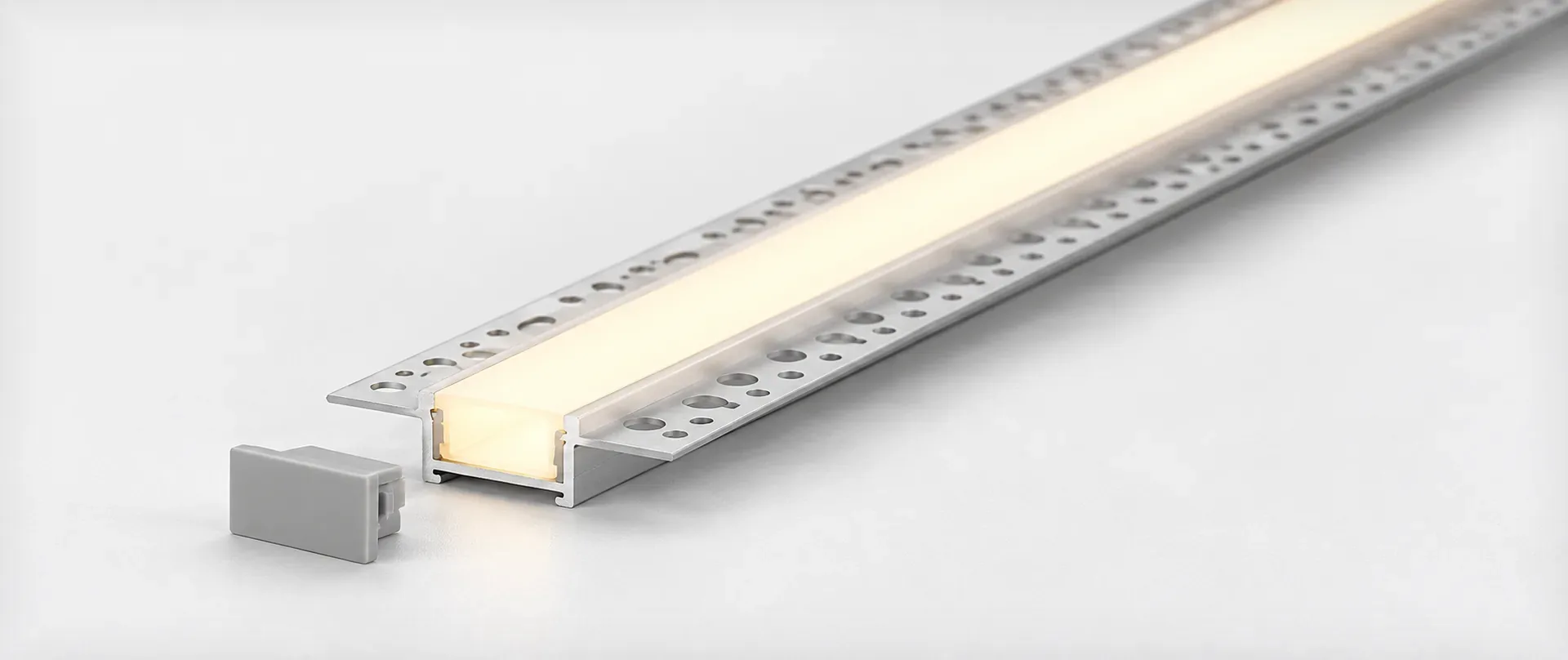
A plaster-in LED profile is an aluminium LED channel that is plastered into a wall or ceiling. Its flanges are skimmed over, so when the room is painted there is no visible trim: only a clean line of light in the surface. It is also called a plaster-in LED channel, a trimless LED profile or a drywall LED channel. In the UK the board is plasterboard; in the US it is drywall.
Plaster-in or recessed?
Both sit in a slot cut in the surface. The difference is the edge.
- A recessed profile has a lip that covers the cut edge. The lip stays visible as a thin aluminium frame around the light. Artcolor's recessed profiles need a 17–35 mm cut-out, by model.
- A plaster-in profile has wide flanges that sit on the face of the board and are buried under the skim coat. Nothing but the light line is left to see.
Choose recessed when the surface is already finished or the fitter has no plasterer. Choose plaster-in when the line has to disappear into the architecture, as in hotel corridors, gallery walls, stair walls and ceiling lines.
Artcolor's plaster-in LED profiles
| Model | Size (W × H) | Channel | Body in the slot | LED strip |
|---|---|---|---|---|
| AL-3612 | 36.2 × 12.2 mm | 10.3 mm | 12.7 mm | 8 mm |
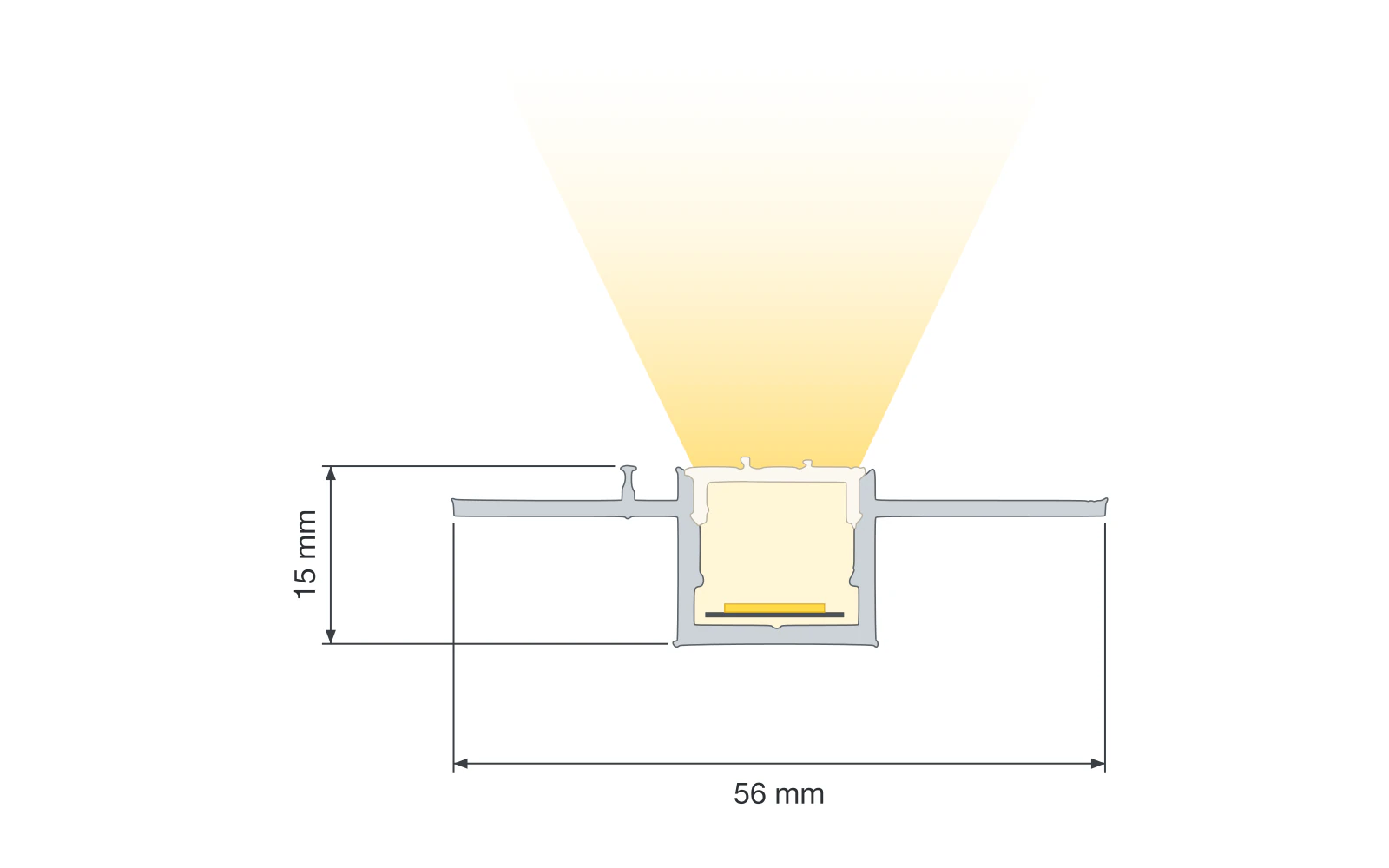
| AL-5615 | 56 × 15 mm | 14.1 mm | 17 mm | 12 mm |
Both are 6063-T5 aluminium, cut to 1, 2.5, 3, 4, 5 or 6 m, with push-in clear, diffuser, opal or black covers and matching end caps. AL-3612 is the slimmer line for 8 mm strips; AL-5615 takes 12 mm strips for more light. Check each profile's height against the board and the batten or frame behind it.
How a plaster-in profile is fitted
The usual sequence is below. Follow the plasterer's own system for tape, filler and drying times.
- Mark the line on the board and check it against the ceiling grid or the wall setting-out.
- Cut the slot to the profile's body width, 12.7 mm for AL-3612 or 17 mm for AL-5615.
- Fix the profile into the slot so the flanges sit flat on the board face.
- Mask the channel so filler cannot get into it.
- Tape and fill over the flanges, then skim, sand and paint as one surface with the wall or ceiling.
- After decorating, fit the LED strip, push in the cover and fit the end caps.
The cover pushes in, so the strip can be reached later from the front.
What to settle before the plasterer starts
Once a plaster-in profile is skimmed in, the profile itself does not move. Decide these first:
- The strip and its lm/m. The channel width fixes the strip width: 8 mm for AL-3612, 12 mm for AL-5615.
- Heat. The aluminium carries heat along the line, but the space behind plasterboard is often closed. Keep W/m sensible; see why LED strips fade in sealed coves.
- Feed points and cable routes. Plan where each run is fed, and run the cables before the board goes up. One end feed reaches about 5 m on 12 V and 8–10 m on 24 V; see choosing LED strip voltage.
- Drivers. Place them where they can be reached, behind an access panel, not sealed in the wall.
- The cover. Opal gives the most even line in a flush surface. See the cover table in how to choose an LED strip channel.
- Ends, corners and joins. Decide how the line stops, turns and joins before the slot is cut.
Plaster-in LED profile FAQ
What is a plaster-in LED profile?
An aluminium LED channel with wide flanges that is set into a slot in plasterboard and skimmed over, so the finished surface shows only a line of light and no trim.
What is the difference between a recessed and a plaster-in LED profile?
A recessed profile has a visible lip that covers the cut edge. A plaster-in profile's flanges are buried under the plaster, so no trim shows.
Can the LED strip be replaced after plastering?
Yes. The strip sits on the floor of the channel and the cover pushes in, so both can be reached from the front without touching the plaster.
Planning flush light lines?
Browse the aluminium LED profiles, or send us the wall or ceiling detail, the board thickness and the line lengths. We will suggest the profile, strip and cover.
- Guides
- LED channel
- Plaster-in