
2 min readBy Artcolor
"LED strip, 3000K" is not a specification. Seven lines that make it one
A short film and a checklist: how to choose between strip, neon flex and wall washer, and the terms that turn one vague schedule line into a specification someone can build.
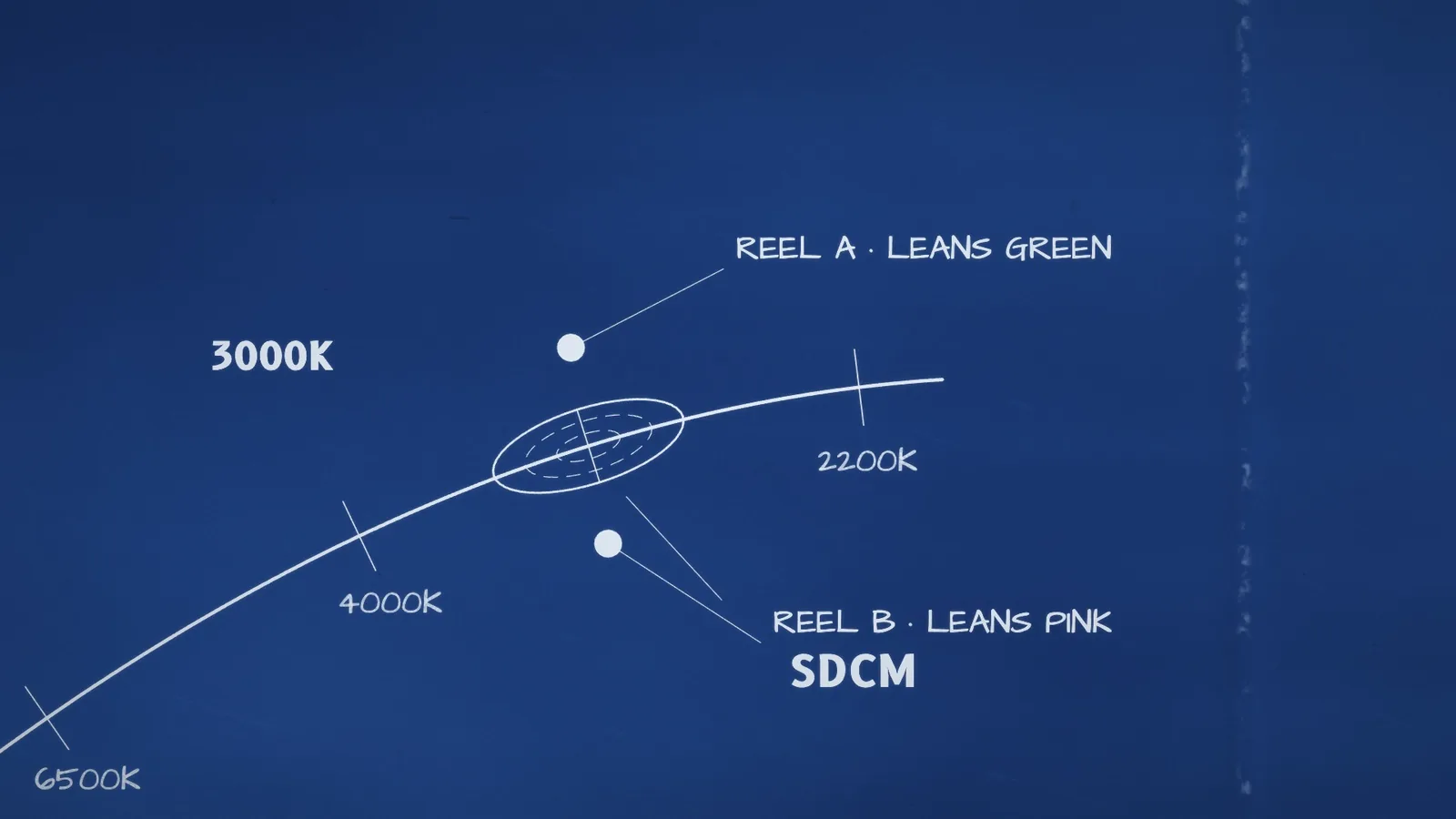
Many lighting schedules still carry a line like "LED strip, 3000K". It names a product and a colour temperature, and leaves almost everything else open: which white, how it renders colour, how it is powered, how the light lands, how it is protected and how it is controlled.
This short film draws that line on a blueprint and revises it seven times, until it is a specification.
1. Family: choose by the job
- Strip in an aluminium profile for coves, shelves and joinery.
- Neon flex for one continuous, dot-free line.
- A wall washer when the wall itself is the subject.
See the product range for each family.
2. White: CCT is only the start
Two reels can both say 3000K and still look green and pink side by side. Write down the chromaticity and the permitted variation (SDCM), and keep one LED bin per continuous line. More in Same 3000K, different white.
3. Rendering: Ra and R9
Ra (CRI) is the average of eight test colours and does not include the saturated red, R9. When skin, textiles or art are lit, ask for R9, and TM-30 where colour is critical. More in CRI 90+ isn't the whole story.
4. Power: voltage and feeds
Voltage sets the current, and the current sets the voltage drop along a run. Every Artcolor strip is specified for runs of up to 5 m per power feed; plan the feeds before the joinery is built. More in 12 V, 24 V or 48 V? and LED strip, heat and sealed coves.
5. Optics: the beam is not the wash
Beam angle sets the spread, but the lens, the output and the setback decide how a wall washes. Narrow beams placed far apart leave dark scallops between them. Mock up a section on the real finish. More on the optics section of our technology page.
6. Protection: the finished assembly
Protection, UV and chemical resistance apply to the selected material and the finished assembly: extrusion, end caps, cable exit and seals. A strip alone does not carry a rating.
7. Control: match the protocol
DALI, 0/1–10 V and phase-cut control need a compatible driver or interface. Pixel lines on SPI need the right IC, and pixel length is model-specific. More in Why there's no such thing as a "DALI strip" and Pixel length on SPI LED strip.
The checklist
| Rev. | Line in the specification |
|---|---|
| 1 | Family: strip in a profile, neon flex or wall washer |
| 2 | White: CCT, chromaticity and SDCM, one LED bin per line |
| 3 | Rendering: Ra and R9 (TM-30 where colour is critical) |
| 4 | Power: voltage, W/m, run lengths and feed points |
| 5 | Optics: beam, output, setback, mock-up on the real finish |
| 6 | Protection: rated as the finished assembly |
| 7 | Control: protocol, driver or interface, IC for pixel lines |
Send us the drawing and these seven lines, and we will recommend products and prepare samples: contact us or email sales@artcolorled.com. The engineering behind each line is on our technology page.
- Guides
- Specification
- Video