
2 min readBy Artcolor
The strip is hidden. Its reflection isn't. Avoiding LED dots in showcases
A concealed LED strip can still show up as a row of bright dots in glass, polished stone or a jewellery case. Why it happens and how to design it out.
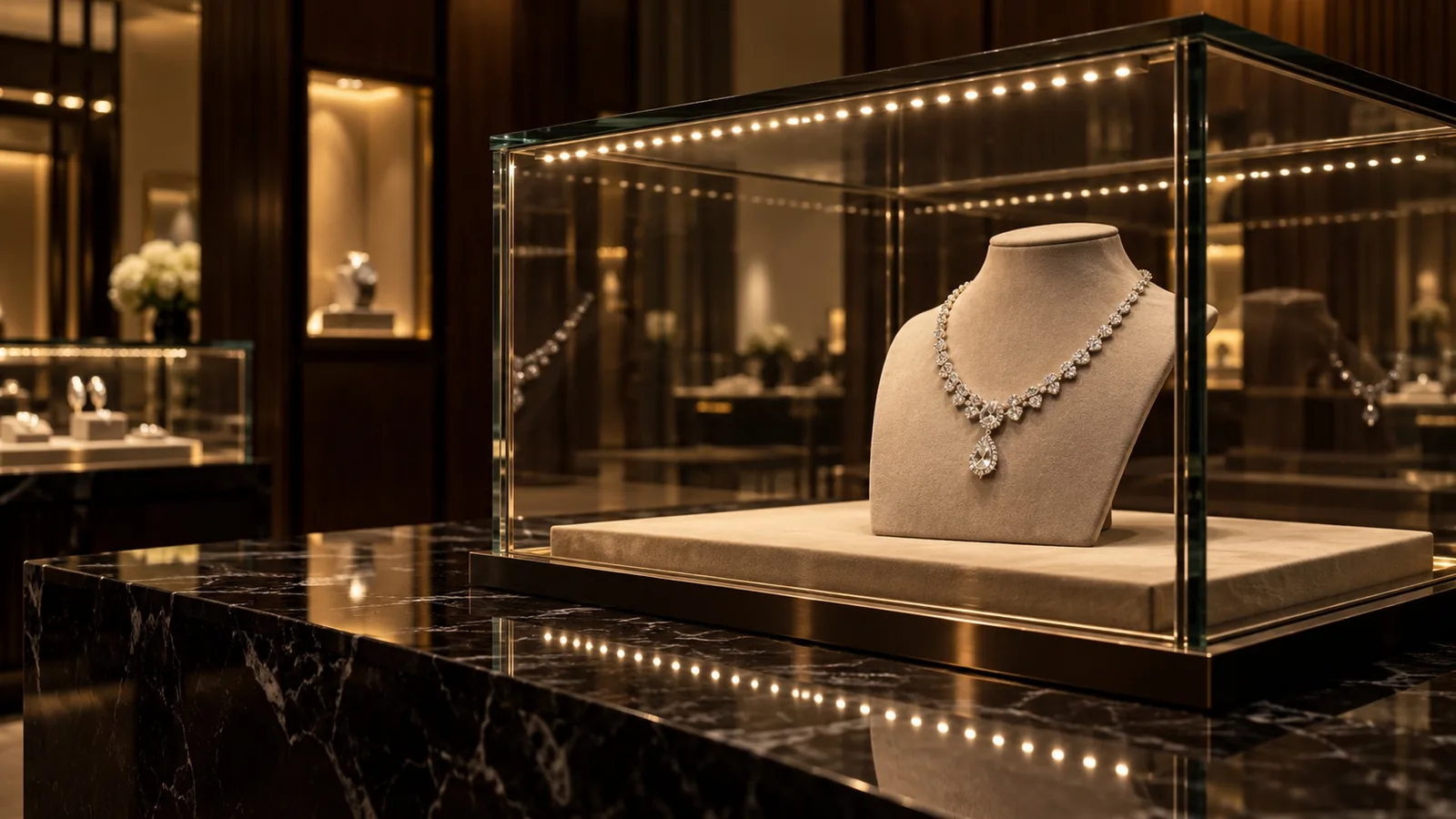
The strip is hidden in the showcase frame. Nobody can see it from the front. Then a customer leans in, and there it is: a neat row of bright dots, reflected in the glass, the polished stone base or the mirror at the back of the case.
In jewellery, watch and luxury retail, that reflection is often more visible than the product the light was meant to show.
Why the dots appear
An LED strip is a line of small, bright points. Behind a diffuser, those points blend into a line, if the diffuser is far enough away and diffuses enough. When it isn't, you see individual hot spots.
Reflections make it worse. A polished surface acts as a mirror, so it shows the source directly, at full brightness, often from an angle you didn't check during design. A diffuser alone doesn't always fix it. Whether dots show depends on:
- LED pitch: how far apart the LEDs are on the strip.
- Distance to the diffuser: the depth of the profile or channel.
- The diffuser itself: its material and geometry.
- The viewing angle: and, in a showcase, every reflective surface around the light.
What helps
- Choose the light source and the profile together. The strip, the profile depth and the diffuser are one optical system. Specifying them separately is how dots get through.
- Use COB or dotless strips where reflections can't be avoided. On a COB strip the LEDs are packed so densely that the line reads as continuous. Our dotless LED strips are designed for applications where a continuous line matters.
- Pick the diffuser for the job, not only for looks. As our technology page puts it: select the material and diffuser geometry for transmission, flexibility, surface appearance and operating environment.
- Check the mock-up from where people stand. Look from the customer's eye height and position, at the glass, the base and any mirror, not from the ladder during installation.
Where it matters most
- Jewellery and watch showcases, with glass on several sides and polished bases.
- Glass shelving in retail and hospitality, where each shelf edge reflects the strip above.
- Polished stone and lacquer: reception desks, bar counters and floors under coves.
- Mirrors in fitting rooms and bathrooms.
The goal
Good display lighting is something people see by, not something they look at. If the light source itself becomes visible, even only as a reflection, it competes with the product.
If you're planning showcases or shelving with reflective materials, send us the section drawing and the materials, and we will suggest a strip, profile and diffuser to sample together.
- Guides
- LED strip
- Retail lighting